
Tyler, TX · Garage Door Service
Garage Doors on Tyler's 1980s and 90s Housing Stock
Most Tyler houses went up between 1966 and 2008, with the bulk from the 1980s and 90s. That era of construction shapes what breaks and what it costs to fix.
- Repairs & new doors
- Springs & openers
- Serving 4 nearby communities
The Situation
Tyler's housing mostly went up between 1966 and 2008, with the median build year landing around 1988. That's not a coincidence of record-keeping - it's a real building boom that shaped fifteen named areas of the service territory, most of it filled in during the 1980s and 90s. If your house falls in that window, your garage door is probably original hardware on a replacement panel, or a full replacement someone did on the cheap when the first door wore out. Either way, you're dealing with torsion springs sized for doors that are lighter than what's sold today, tracks mounted to framing that was never meant to carry an insulated panel, and openers that have outlived at least one remote control standard.
Houses from this era rarely have the wall thickness or header clearance that newer code requires, which matters when you're swapping in a modern door. A door built to current specs can be heavier and thicker than what the opening was framed for in 1985. That's the single biggest surprise owners run into here - not that the door failed, but that the replacement doesn't fit the way they expected.
When to Get Help
Call before the door is all the way down to the floor and stuck. A torsion spring on a double door built in the 1980s or 90s often snaps without warning - you'll hear a bang, and the door will feel like it weighs twice as much when you try to lift it by hand. Don't try to force it open with the opener; that just burns out the motor on top of a broken spring.
If the door is original to a house from this stock and the track has started to pull away from the jamb, that's worth a look even if the door still runs. Framing from this period wasn't always built to the same tolerances as current code, and a track that's slowly working loose on 30-year-old lumber is a different repair than one on new construction.
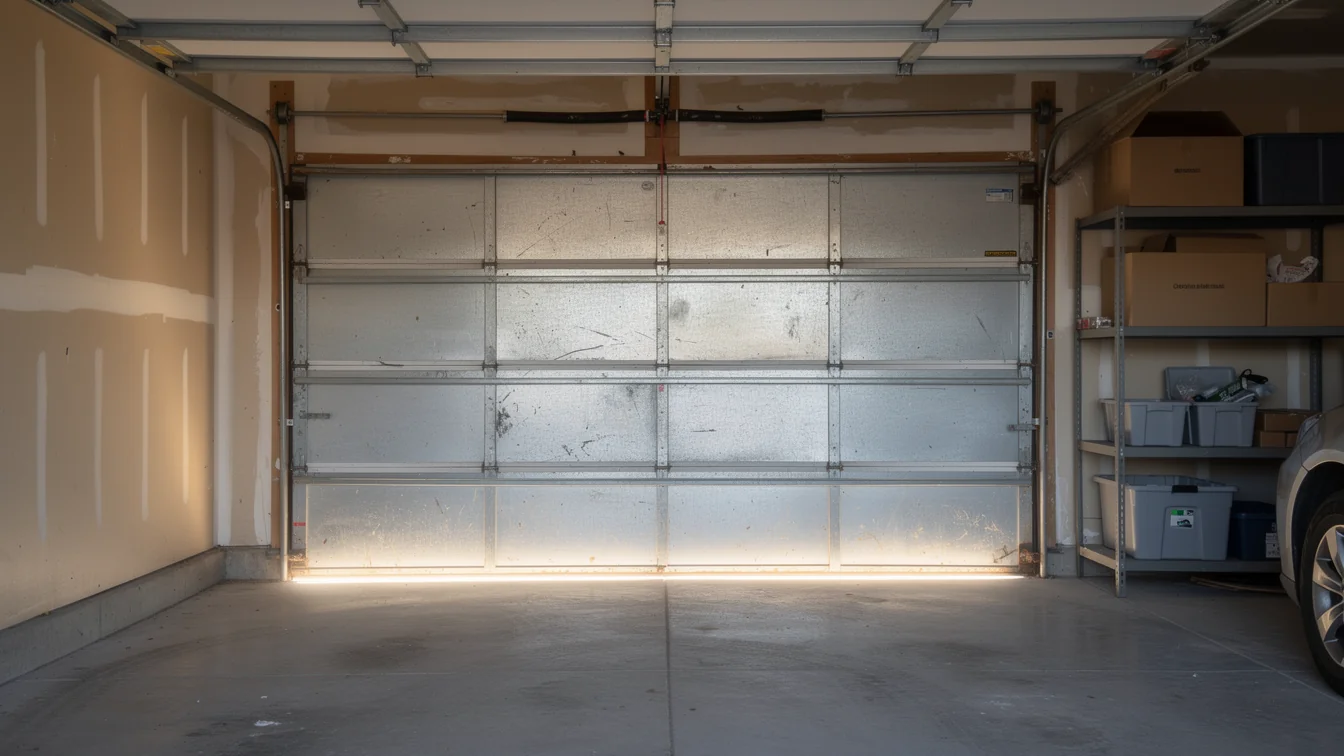
One limitation worth saying plainly: if the door is original glass-panel steel from the 80s and the panels are rusted through or the seams have separated, patching isn't worth the labor. At that point you're better off replacing the door than chasing rust with a grinder.
How Local Conditions Play In
Tyler sits in a mild climate with occasional freeze, which is gentler on hardware than a true hard-freeze zone, but it's not nothing. Galvanized spring coils and cable still take a toll from the freeze-thaw cycle that shows up most winters, and a spring that's been flexing for thirty-plus years on a house from the 1966-2008 build window is closer to the end of its life than the middle of it.
The mild-with-some-freeze pattern also means condensation is more of a daily issue than ice is. Steel doors without a thermal break - common on houses built before insulation rules were standard - sweat on the inside face during cool, damp mornings. Over enough years that moisture finds the bottom corners of the panel first, which is where you'll see rust starting on original doors from this era before anywhere else.
What You Pay
What a job costs here depends heavily on what era your door and opening came from. A door on a house built in the 1966-2008 window with original hardware is usually a straightforward spring or cable swap - the parts are standard sizes, nothing exotic. Where it gets more expensive is when the opening itself needs work: widening a header, reinforcing a track mount on older framing, or dealing with a door that doesn't match current panel thickness standards.
With a median household income of $65,250 across the service area and roughly 9,787 owner-occupied houses out of 13,624 households, most of the calls here are homeowners making a practical repair-versus-replace call on a house they've lived in for years, not a quick flip decision. That's worth knowing going in: a repair on older hardware can be the right call, but if the door itself is the problem - not just a worn part - replacement often pencils out better over time than a second or third patch job.
Frequently asked questions
Is my garage door too old to repair if my house was built in the 80s or 90s?
Not necessarily. Most of Tyler's housing stock dates from 1966 to 2008, with a lot of it from the 1980s and 90s, and that era's doors use standard spring and cable sizes that are still easy to source. The hardware isn't the problem - rust-through panels or a warped track usually are.
Why does my garage door sweat on cool mornings?
Tyler's climate is mild with occasional freeze, which means more damp, cool mornings than hard freezes. Steel doors without a thermal break - common on houses built before insulation rules became standard - condense moisture on the inside face. Over years that moisture collects at the bottom panel seams first.
Will a new door fit my old opening?
Sometimes not without extra work. Houses from the 1966-2008 building window were often framed for lighter, thinner doors than what's sold today. A header or track mount built to older tolerances may need reinforcing before a modern insulated door will sit right.
Related garage door services in Tyler
More garage door guides
Book garage door service in Tyler
Call now or request a quote - tell us what the door is doing and where you are.