
Tyler, TX · Garage Door Service
When a Spring Goes in Cold Weather, Here's What's Really Happening
Tyler's mild-but-freezing winters and 1966-2008 housing stock mean torsion springs here fail in a specific, predictable way. Here's what that looks like and what it costs.
- Repairs & new doors
- Springs & openers
- Serving 4 nearby communities
The Situation
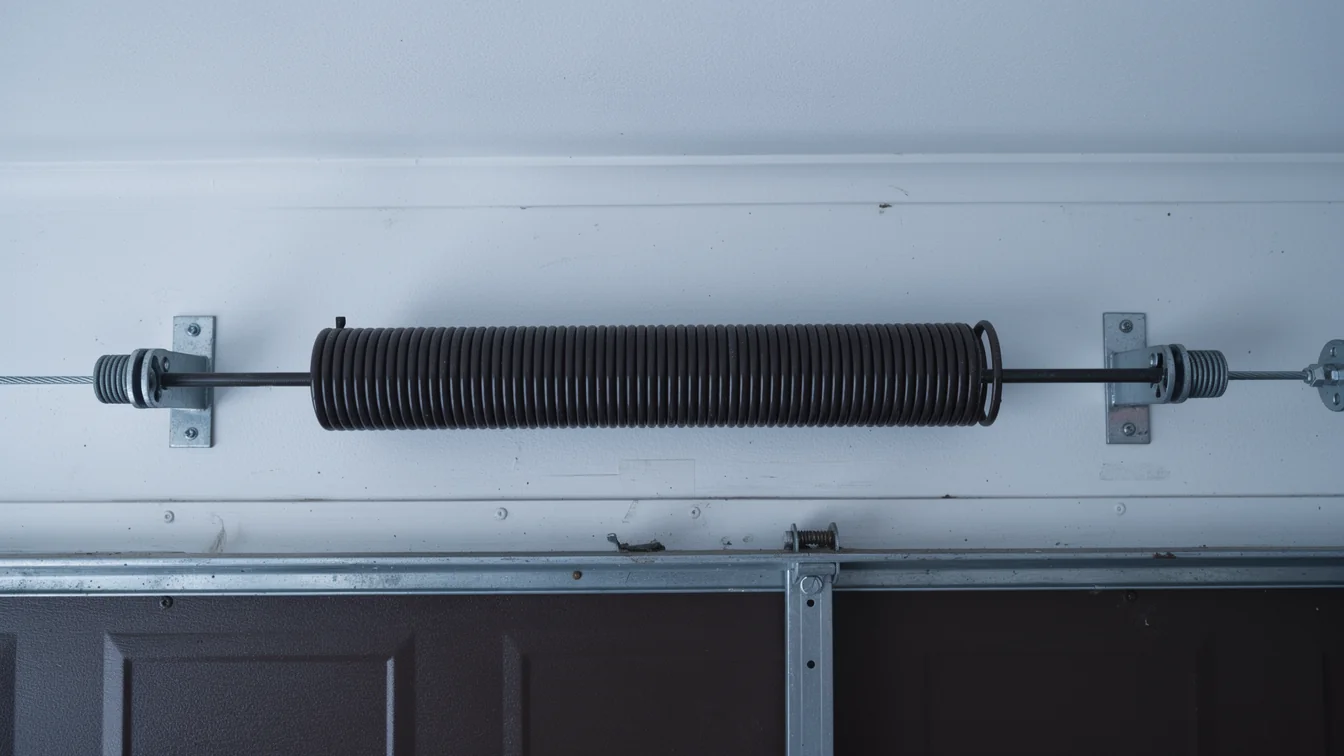
Most of the houses we get calls to went up between 1966 and 2008, with the typical build year sitting right around 1988. That matters because a torsion spring is rated for a number of open-close cycles, not years, and a spring installed during that build wave is now well past its working life whether anyone's touched it or not.
Then a cold front rolls through. Tyler sits in a mild climate band, but it still gets the occasional freeze, and steel contracts when it's cold. A spring that's already fatigued from three decades of cycling loses a little more flex right when the temperature drops, and that's the morning the door won't lift, or lifts crooked, or the spring just lets go with a bang loud enough to bring a neighbor over.
This isn't a coincidence pattern. It's the same story on a lot of the 1980s and 90s builds scattered across the fifteen named areas we work in - the door is original, or close to it, and the first real cold snap of the season is what finally finds the weak point.
If your door's acting different only on the colder mornings, that's not your imagination. That's the spring telling you something.
When to Get Help
Call before it breaks, not after, if you can catch the signs. A door that's noticeably heavier to lift by hand on a cold morning than it was in summer is losing spring tension gradually - that's worth a look. So is a door that hangs crooked at one corner, or a loud bang from the garage followed by a door that won't budge at all. That second one is a broken spring, full stop, and the door shouldn't be forced open or closed with a broken spring under tension.
What doesn't need an emergency call: a door that's just a little slow or slightly noisy but still opens evenly. That can usually wait for a scheduled visit rather than an after-hours one.
Here's the honest limitation: we can't tell you over the phone whether you've got a broken spring or a motor problem or a track out of alignment. Cold-weather symptoms overlap - a frozen opener gear and a cracked spring can sound almost the same from inside the house. Someone needs to look at the door itself before we know which repair you actually need, and guessing wrong wastes your time and ours.
How Local Conditions Play In
Tyler's climate band is mild with occasional freeze - not the kind of winter that cracks concrete, but enough cold snaps each year to stress-test aging hardware. A spring doesn't need deep freeze to fail; it needs one cold morning after years of wear, and that's what this climate delivers a handful of times a season.
The housing stock compounds it. A home built in the 1980s or 90s - which covers most of what's out here - was very likely fitted with a standard torsion spring setup that nobody's replaced since. Thirty-plus years of cycling on original hardware, combined with a seasonal cold snap, is a specific and repeatable failure pattern, not bad luck.
Across the service area - 13,624 households, with 9,787 of those owner-occupied houses - that means a large share of the calls we take are from people living in a house whose garage door hardware is original to a build year decades back. It's not a question of whether the spring will eventually go, just when the next cold morning lines up with the wear that's already there.
What You Pay
We don't have a flat number to hand you here, and giving one would be a guess dressed up as a fact. Spring jobs vary by door size, spring type, and whether one side or both sides need replacing - a single spring job and a double-spring job on a wide two-car door aren't the same cost, and we're not going to pretend otherwise without seeing the door.
What we can tell you is what drives the number: door weight, spring size and cycle rating, and whether the cold snap also knocked something else loose - a cable, a roller, the opener's cold-start behavior. A tech who's actually standing in front of the door can tell you in a few minutes which of those apply to your situation.
Median household income across the service area is $65,250, and we hear plenty of homeowners weighing repair against replacement on that budget. That's a fair question to ask out loud when you call - whether a full repair makes more sense than patching one spring on an old opener - and it's one we'll answer honestly once we've looked at the door, not before.
Frequently asked questions
Why did my spring break on such a cold morning?
Steel loses some flexibility in cold, and Tyler gets occasional freezes even though the overall climate is mild. A spring that's already worn from years of cycling - common in houses built in the 1980s and 90s - is more likely to finally give out on that first cold snap than on a warm afternoon.
Can I just use the door manually until it gets fixed?
Not if the spring is actually broken. A broken torsion spring means the door has no counterbalance, so it's heavy, unpredictable, and can drop fast. Leave it closed and call rather than forcing it by hand.
Is a cold-weather spring failure different from a regular one?
The spring itself fails the same way either way - metal fatigue after years of cycles. Cold weather doesn't cause the failure, it just tends to be the final push on a spring that was already near the end of its life, which is why these calls cluster in the colder months.
How old does a spring usually get before this happens?
We don't have a universal number - it depends on cycles, not calendar years. But a lot of the homes we see with this problem were built decades ago, in the 1966-2008 range typical for this area, and still have the original spring setup.
Related garage door services in Tyler
More garage door guides
Book garage door service in Tyler
Call now or request a quote - tell us what the door is doing and where you are.